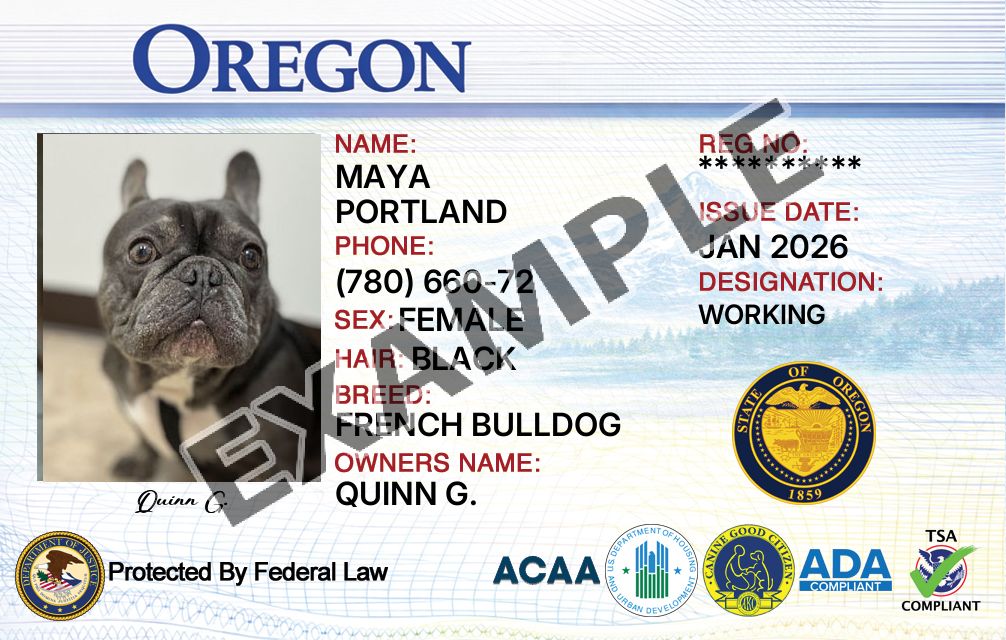
If you’re asking where do I register my dog in Coos County, Oregon for my service dog or emotional support dog, the key detail is this: dog “registration” is usually a local dog license (a county or city requirement), while service dog and emotional support animal (ESA) status are legal categories that do not come from a county license office.
This page explains where to register a dog in Coos County, Oregon, what documents you need (especially rabies vaccination proof), and how local licensing interacts with service dog and ESA rules.
Where to Register or License Your Dog in Coos County, Oregon
Start with the office that covers the address where your dog lives. In many parts of the county, licensing is processed through the Coos County Clerk (with the Sheriff’s Office Animal Control program closely involved in enforcement and shelter operations). If you live inside certain city limits, your city may have additional animal rules, so it’s still smart to confirm which office is the correct first stop for an animal control dog license Coos County, Oregon question.
Coos County Clerk (Dog Licensing)
| Address | 250 N Baxter St |
|---|---|
| City/State/ZIP | Coquille, OR 97423 |
| Phone | 541-396-7602 |
| Not listed | |
| Office hours | Not listed |
Tip: Coos County licensing guidance notes licenses are issued by the Clerk’s Office and its licensing agents, and that licensing timing is tied to age/residency and rabies expiration.
Coos County Animal Control / Coos County Animal Shelter (Animal Control & Shelter Operations)
| Address | 92960 Southport Rd |
|---|---|
| City/State/ZIP | Coos Bay, OR 97420 |
| Phone | 541-751-2480 |
| ccas@co.coos.or.us | |
| Office hours | Noon–4pm Tuesday–Saturday |
Animal Control can be the right contact for enforcement questions, stray/impound issues, and guidance when you’re unsure which local authority covers your address.
Coos County Sheriff’s Office (Non-Emergency Dispatch for Animal Control Response)
| Address | Not listed |
|---|---|
| City/State/ZIP | Not listed |
| Phone | 541-269-8911 ext 1 (Dispatch – Non Emergency) |
| Not listed | |
| Office hours | Not listed |
Use dispatch for urgent animal control situations (for example, aggressive dog incidents) when instructed by county animal control guidance.
Overview of Dog Licensing in Coos County, Oregon
What “registering your dog” usually means
In everyday terms, when people ask where to register a dog in Coos County, Oregon, they typically mean getting a dog license in Coos County, Oregon. A dog license is a local government record that connects a dog to an owner and helps support animal control and shelter services. It is also often used to encourage compliance with basic public health requirements like rabies vaccination.
Who sets the rules?
Licensing requirements are often established and enforced locally. In Coos County, licensing information indicates dogs must be licensed based on age (or when permanent canines appear) and within a timeframe after becoming a resident, and that licensing is processed through the Coos County Clerk and licensing agents.
How long the license lasts
Licenses are typically issued for set terms (for example, one year or three years). In Coos County, the license term is tied to the rabies vaccination expiration—meaning the license can only remain valid up to the first rabies expiration date.
How Dog Licensing Works Locally in Coos County, Oregon
Step 1: Confirm whether you’re in a city limit or unincorporated Coos County
Because licensing and enforcement can be handled at the county or city level, your first step is to identify whether your home is within a city limit (for example, Coos Bay, North Bend, Coquille, Bandon, Myrtle Point, Powers, etc.) or in an unincorporated area. If you are in a city limit, the city may have additional animal rules (like special permits for certain animals), while the county provides the standard licensing pathway and animal control services for many areas.
Step 2: Gather required documents (rabies + spay/neuter proof if applicable)
Coos County licensing instructions specify that you should provide a certificate of rabies vaccination from a licensed veterinarian (not an invoice/receipt). If you want the altered (spayed/neutered) license rate, you’ll also need a certificate/proof of spay or neuter from a licensed veterinarian (again, not merely an invoice/receipt). Keep copies for your records.
Step 3: Submit your application and pay the fee
Coos County provides mail-in instructions that include sending documentation and the fee to the Coos County Clerk’s Office (Attn: Dogs). Fees vary depending on whether the dog is spayed/neutered and whether you choose a 1-year or 3-year license. County-published amounts include: a reduced fee for altered dogs and a higher fee for unaltered dogs, with multi-year options.
Step 4: Receive your license/tag and keep it current
After processing, the county mails your dog license and returns certificates. Renew before expiration to avoid late fees and to ensure your dog’s records remain current in case of a stray pickup, bite investigation, or other animal control contact.
Service Dog Laws in Coos County, Oregon
A county dog license is not “service dog registration”
A common point of confusion behind the query where do I register my dog in Coos County, Oregon for my service dog or emotional support dog is the idea that you must file special paperwork with the county to make a dog a service dog. In general, service dog status comes from the dog’s training and the handler’s disability-related need, not from a county licensing counter.
Public access: what matters for service dogs
Service dogs are generally allowed to accompany their handler in public places where pets are not allowed, as long as the dog is under control and housebroken. Businesses typically may ask limited questions (commonly: whether the dog is required because of a disability and what work/tasks the dog is trained to perform), but they generally cannot demand paperwork as a condition of entry.
Service dogs still follow local health and licensing rules
Even when a dog is a legitimate service dog, it is still usually subject to local animal laws that apply to all dogs, including a dog license in Coos County, Oregon and rabies vaccination requirements. In other words, service dog legal status does not replace the local license—think of them as two separate systems: local licensing (county/city) and disability access law (state/federal).
Emotional Support Animal Rules in Coos County, Oregon
ESAs are not service dogs
Emotional support animals (ESAs) provide comfort by their presence, but they are not the same as service dogs trained to perform tasks. This distinction matters because ESAs generally do not have the same public access rights as service dogs in restaurants, stores, and other public places.
Housing is where ESA documentation most often applies
Most ESA-related documentation issues come up in housing situations (for example, requesting a reasonable accommodation for an ESA in a no-pet building). While landlords may request reliable documentation supporting the need, that documentation is not a substitute for a local county dog license.
ESAs still need local licensing and rabies vaccination
If your ESA is a dog living in Coos County, you still need to follow local rules for an animal control dog license Coos County, Oregon and keep rabies vaccination current. Local licensing is about identification, public health, and enforcement—not about verifying a disability-related need.
Overview of Dog Licensing in Coos County, Oregon (Rabies & Compliance)
Rabies vaccination requirements
Oregon requires dogs to be vaccinated against rabies. Coos County licensing guidance specifically links licensing to rabies compliance by requiring a rabies vaccination certificate for licensing and by limiting the license term to the first rabies expiration date. Practically, this means: if your dog’s rabies shot expires sooner than the license term you want, the license cannot extend beyond that rabies expiration.
Why rabies documentation matters for licensing
Rabies is a serious public health issue. Keeping rabies vaccination up to date helps reduce risk and also simplifies things if there is ever a bite incident, quarantine question, or animal control investigation. For licensing, the document that matters is the vaccination certificate issued by the veterinarian, not a receipt.
Age/residency timing (when you must license)
Coos County licensing guidance states dogs must be licensed at 6 months of age (or when permanent canine teeth appear), or within 30 days of becoming a resident. If you recently moved into Coos County, it’s a good idea to start the licensing process promptly so you remain compliant.
Frequently Asked Questions
You typically do not need a special county registration to “certify” a service dog. What you do usually need is the standard dog license in Coos County, Oregon (local licensing) plus compliance with rabies vaccination requirements. Service dog status is based on training and disability-related need, not a county-issued service dog card.
In many cases, you can license through the Coos County Clerk (mail-in licensing is described by the county). If you are uncertain which local authority covers your address, contact the Coos County Animal Shelter/Animal Control for guidance.
- Rabies vaccination certificate from a licensed veterinarian (not a receipt)
- Spay/neuter certificate (if applying for altered pricing)
- Owner contact information and address details
- Licensing fee (varies by term and altered/unaltered status)
No. An ESA letter (when legitimately used) relates mainly to housing accommodations. A county dog license is a separate local requirement tied to identification, public health, and enforcement. Even if your dog is an ESA, you still generally need to follow the local rules for where to register a dog in Coos County, Oregon.
Coos County licensing guidance ties validity to rabies vaccination status. If a rabies certificate expires before a 1-year or 3-year term would end, the license can only remain valid until the first rabies expiration date. This encourages continuous rabies compliance for public health.